Especially in the last few years, artificial intelligence, AI automation, digitalization, the contribution of artificial intelligence to the professional workforce in terms of productivity, and the risks and opportunities brought by artificial intelligence have been talked about extensively in all sectors and platforms.
Just as it affects every sector, it also affects the healthcare sector in a profound and revolutionary way. It is obvious that a lot of progress has been made, especially in the diagnostic part of the work.
The developments and readings in the field of artificial intelligence and diagnostics, its contributions to physicians and health professionals, are examined functionally with clinical experiments, test and control groups. Its success and effectiveness are evaluated again and again every day.
There are many studies showing that many risky situations that may go unnoticed due to human errors can be detected with greater accuracy.
In this article, I do not aim to address false-positive or false-negative issues or examine the relationship between the medical profession and artificial intelligence. The scientific dimension of this business, which can most deeply affect clinical and human health, is that many companies and research institutes in the world are investing billions of dollars in R&D in this field and continue to do so.
In this article, I will focus on efficiency in the field of health communication and health tourism, minimizing human errors, standardizing and tracking processes, and how different business lines in the health sector and health habitat are affected by this artificial intelligence revolution, with tangible, currently implemented functional applications and outputs.
Actually, this is the scientific dimension that can affect clinical and human health most deeply. As a result of the developments and as a case, I aimed to explain why Projemed Health Communication and Advertising Agency had to develop its own health CRM and artificial intelligence agent, against the backdrop of the developments in the world and in Turkey.
As an agency that does brand and communication management and performance marketing for the health sector, seeing the needs and deficiencies in this field, why is there a need to develop an artificial intelligence-supported CRM software that is planned exactly according to the needs of the health economy, as many similar applications in the market are designed according to general needs? Have we heard?
In order to examine this issue correctly, let's briefly remember the developments in the world and in Turkey together, and while thinking about it, let's evaluate together not the answers but the right questions. What do you think?
If Omnichannel exists, CRM is a must, and AI is now indispensable…
2025 will be the year when artificial intelligence in patient relationship management (CRM) has descended to the level of "agents on duty" (agent AI); It is the year when appointment, reminder, post-discharge communication, treatment compliance and personal training contents are integrated with smart automation. What makes the difference for healthcare organizations; To be able to establish an architecture that connects single channel to omnichannel, data to intuition and the marketing-CRM-clinical triangle.
In the marketing and communication part of the business, most health habitat stakeholders also have to work with communication and brand agencies.
Instant monitoring of the effectiveness and efficiency of the advertisement, especially in the performance part, shows that there is a need for common access platforms between the health agency and the health institution for accessing and tracking data. Studies in the field show that if there is a common platform where the traffic, phone calls and conversions coming from GoogleAds or META or other channels with the condition of advertising are seen and understood together, there is great awareness and ability in competition, adaptation to developments and accurate analysis of the work done.
Obviously, Artificial Intelligence is essential not only in managing advertising but also in meeting incoming traffic. When it comes to ROI, agentic AI and integrated CRM are the success factors. Artificial intelligence, on the other hand, maximizes efficiency and effectiveness both in data analysis and by allowing the flow of digital platform-based communication and lead traffic to be met in situations where people cannot keep up.
An artificial intelligence that responds to phones, correspondence, requests, creates offers, makes appointments, reminds appointments, and provides patient education and information, even while you are sleeping, allows the creation of a circle of trust and security beyond comfort for both the healthcare provider and the healthcare recipient.
So Why Right Now?
Let's take a look at the global analyzes and reports recently made by the world's leading consultancy organizations such as Deloitte and McKinsey on digitalization and artificial intelligence in the healthcare sector.
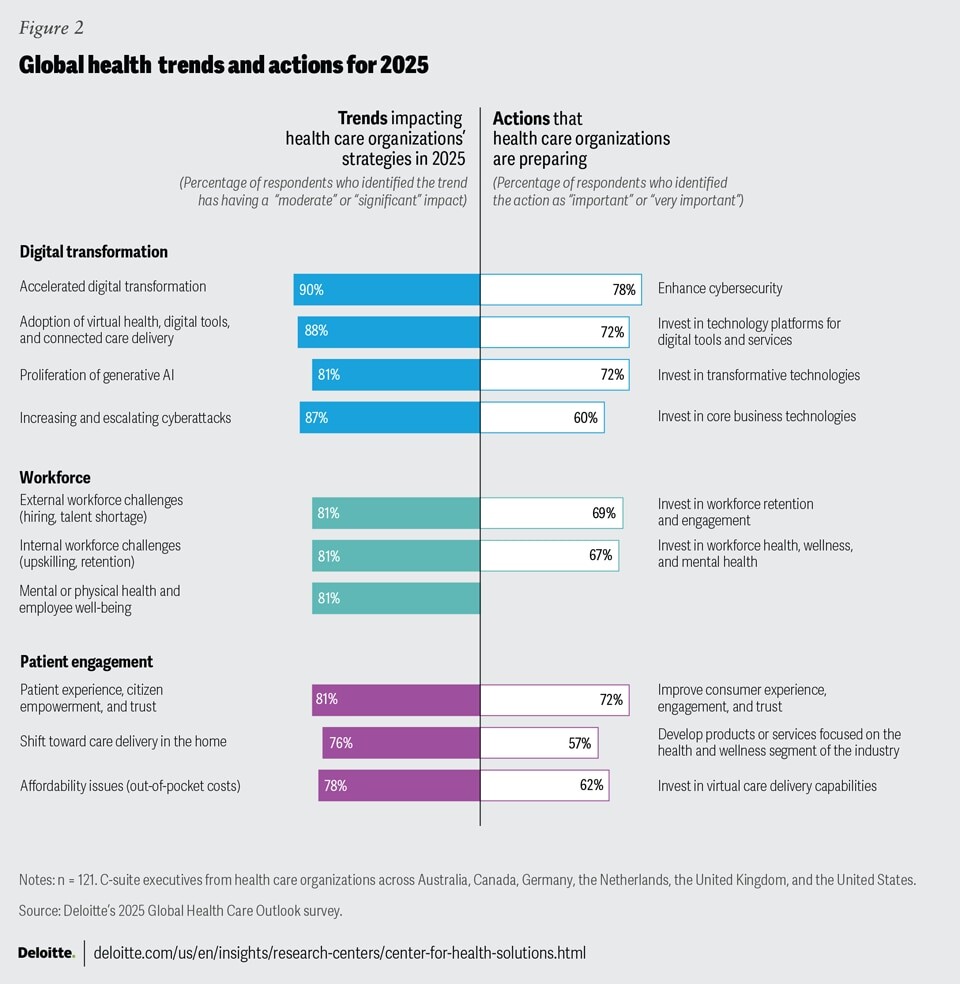
Manager priorities are clear: In 2025, healthcare managers around the world put efficiency, digital transformation and patient interaction in the top three places; The expectation that genAI's impact will be "medium-high" is over 70%.
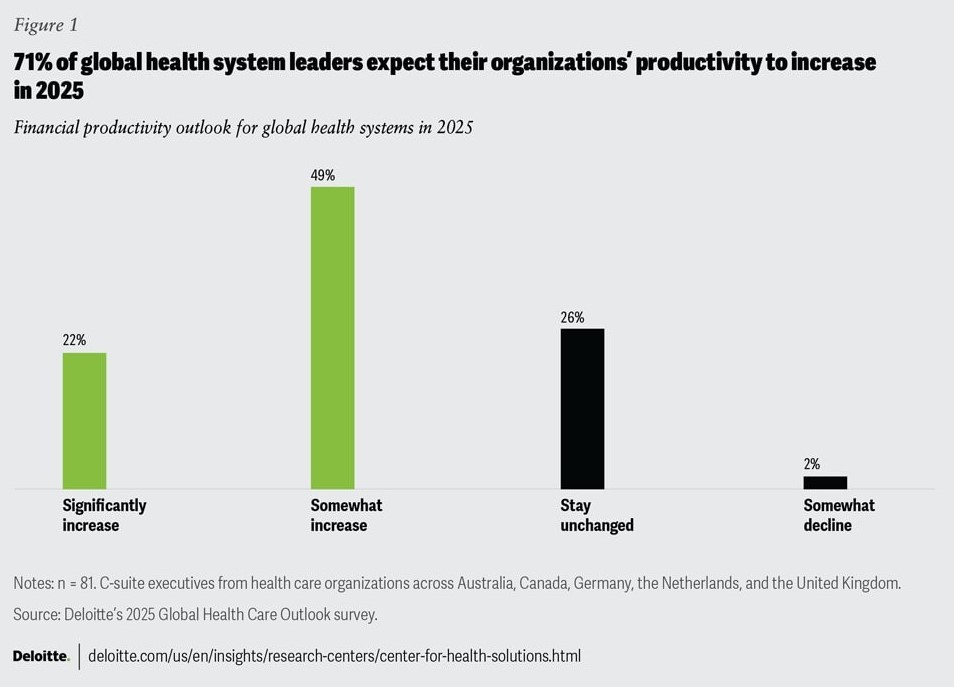
This issue was evaluated in detail in Deloitte's sector analysis titled “2025 global health care outlook _ Survey highlights health system leaders' plans to focus on efficiency, productivity, and patient engagement this year”.
For those who are curious, the report can be found at this link. achievable.
Consumer experience pressure: Artificial intelligence surfaces inaccessible data sources and scales personalized interaction; This directly affects business results.
It is also possible to reach the subject from a broader perspective in the report titled "Harnessing AI to reshape consumer experiences in healthcare" published in 2024 by McKinsey, one of the world's leading consultancy firms. For those who are curious, I leave the link here.
Use of AI in healthcare, automation and digitalization: 2025 Trend Photo
1) Agentic AI and process automation: Task agents that initiate a flow, take action based on data, and complete it with human approval; Initial value fields for tasks such as reminder, appointment, payment notification, discharge summary and “frequently asked questions”.
2) Omnichannel patient communication: Consistent message flow across web, mobile app, WhatsApp/SMS, call center and in-clinic screens.
3) Trust, governance, disclosure: “Human-in-the-loop,” recording and disclosure standards, model neutrality—especially in public systems.
4) Data integration: EHR/PHR data + behavioral data + aggregation of marketing/CRM signals on a single platform.
USA
Scale and investment: GenAI is no longer an “experiment”; A significant portion of institutions are moving to scaling. Areas of use: front office automation (digital front door), patient messages, ambient scribe, revenue cycle.
Lesson: Business value fastest; It comes in the trio of reminder-adaptation-summary. (E.g. discharge summaries and personal training content)
United Kingdom
Public strategy: 10-year plan makes NHS App the hub for AI-powered triage and appointment flows with a “doctor-in-your-pocket” vision.
Implementation framework: NHS Communications AI Operating Framework; requires secure access and human control while personalizing patient communication.
Lesson: Ethics and operations must be designed together; clear guidelines for communications teams are critical.
Singapore
Regulation and sandbox: National HealthTech agency Synapxe accelerates data access and multi-cloud innovation with HealthX Innovation Sandbox 2.0; ministry is establishing AI-SaMD sandbox.
Policy philosophy: Building trust—security/transparency felt by doctor and patient; Based on IMDA-PDPC's Model AI Governance Framework and WEF studies.
Lesson: “Small but fast” approach—regulation, data and pilots are designed together.
China
Scale and speed: With “Internet+Healthcare” policies and investments of technology giants, patient interaction, imaging and smart hospital applications are rapidly spreading; Tencent healthcare solutions emphasize patient self-management and administrative efficiency.
Market dynamics: Health AI market growth is high for 2025 and beyond (reports point to double-digit CAGRs in 2025-2030).
Lesson: Data scale + public support = rapid productization; but security and standards are getting tighter.
Türkiye
National backdrop: National Artificial Intelligence Strategy (2021-2025) and 2024-2025 action plan; It supports the use of AI and the ecosystem in public services.
Digital health infrastructure: National systems such as e-Pulse/MHRS; Collaboration with HIMSS and dissemination of maturity models provides a powerful framework for integration.
Lesson: There is a suitable basis for data-driven personalization within legal boundaries; Fast gains are possible if an integration plan is made.
Our prediction is that the predictions and expectations in this field for 2025 will be much higher in the next year and period by the end of 2025.
So, what are the 6 Fastest Value-Providing Usage Scenarios for AI Integrated CRMs?
Appointment & reminder orchestration: Inter-channel flow (SMS/WhatsApp +) to reduce the no-show rate. e-mail + in-app).
Treatment and medication adherence (adherence): Personal calendar, micro-contents, behavioral persuasion (nudges).
Post-discharge communication: Automatic summary + individual risk/symptom reminders.
Payment and financial communication: Transparent cost, installment/payment reminders, insurance steps.
Patient education and FAQ: Physician-approved microtext and short videos derived from clinical content.
Community-based support: Disease-specific (e.g. oncology, obesity) moderated group interaction.
“Turkey's healthcare sector cannot afford the risk of missing the Artificial Intelligence revolution in patient communication and health tourism patient access.” Aydın Demir.
Türkiye, which is among the top 10 countries in the world in health tourism, has made huge investments in this field compared to its competitors in the world in the last 15 years. If we put aside the quality standardization in business management and the auditing weaknesses caused by very rapid growth, it is still one of the most important players in the world.
However, being able to survive and continue in the competition is directly proportional to rapid adaptation and adaptation to innovation and developments. The Turkish market is a market with human resources that have always demonstrated their ability to adapt and adapt. Even its breakthrough in the last 15 years in health tourism is enough to reveal its talents in this field.
"Every physician, clinic, health institution, health tourism agency and even individual intermediaries should use health-specific CRM structures and Artificial Intelligence integrated systems. This is the key to success in the next 5 years..." Aydın Demir.
Projemed Agency has been operating mainly in the field of health tourism for more than 10 years, working with physicians, clinics, hospitals and health tourism intermediaries. and a creative agency that does content and performance marketing to its agencies. Instead of wasting time with suggestions and guidance on CRM for the brands it manages, it preferred to produce solutions for its brands by producing a cloud CRM system specific to health. This was partly a necessity to ensure the success and accurate measurement of its own agency activities.
Now, instead of making special efforts to explain the benefits and obligations of the Artificial Intelligence revolution, it is trying to strengthen the success and competitive position of its brands by offering its brands specially trained AI health sales structures for the health and services provided, developed just for this job.
What are Medu CRM and MeduAI, how to install them?
1) Data Sets. (layered):
Core health data: PHR/EHR, ICD/LOINC/HL7-FHIR maps (following integration rules).
Behavioral signals: Web/mobile events, open-click, call center notes.
Campaign data: Meta/Google ad clicks, UTM tracking, form and WhatsApp leads.
2) Agents (agent flows):
Appointment agent: Searches for a suitable slot, recommends it to the patient, obtains approval, matches it with the MHRS or institutional calendar.
Compliance agent: Produces personal reminders and “common conditions” guide according to the prescription/treatment plan.
Notification-summary agent: Personalizes the discharge summary/home care steps; In case of risk signs, it warns both the patient and the physician.
3) Human-controlled study (HITL):
Double approval queue for messages requiring clinical approval; high-risk content automatically falls to the editor's desk.
Disclosure note in all streams: "This message has been prepared with AI support; it has been sent with the approval of your doctor."
4) Compliance and security:
KVKK/GDPR compliant data processing; fitness for purpose, minimization, delete-store policies.
Model logs (audit trail), versioning, “shadow risk” assessment; penetration tests.
Ethics & Compliance
Human touch is essential: Public examples clearly call for AI to be positioned as a human-empowering tool.
Disclosure and permission: It should be transparently stated that an AI-supported message is being sent to the patient; the approval and objection mechanism should be easily accessible.
Data fairness: Risks of data representativeness, bias, and access inequality are critical, especially in emerging markets.
How Will We Measure Success? (Recommended KPI Set)
Access and process efficiency
No-show rate ↓
Average appointment completion time ↓
Call center average processing time (AHT) ↓
Clinical adherence
Medication/treatment compliance rate ↑
Re-application after discharge (30 days) ↓
Experience & trust
CSAT/NPS ↑
Satisfaction and trust score after “AI disclosure” ↑ (survey-based)
Data sharing consent rate ↑
Revenue impact
Marketing cost per appointment (CPL/CPA) ↓
Patient lifetime value (pLTV) per channel ↑
It is recommended to report these KPIs separately at the management desk as 90-day "leading metrics" and 12-month "result metrics".
Road Map (90 Days)
0–30 Days
Compliance/evaluation: KVKK/GDPR, explanation texts, data inventory
Integration: EHR/PHR → MeduCRM data schema, UTM/lead flows
Pilot use-case selection: appointment-reminder and discharge summary
31–60 Days
Agent flows: text templates + physician approval queues
Dual-channel broadcast: SMS/WhatsApp + email (with A/B tests)
First KPI dashboard: no-show, open-click, appointment completion duration
61–90 Days
Adherence and financial statements
Omnichannel expansion (mobile application/call center)
Executive summary: ROI/learnings → scaling plan
Result
Global examples; It shows that AI-powered CRM is no longer the “future” but a working reality. Turkey's national strategy, e-Nabız/MHRS and HIMSS collaborations; It offers a strong basis for projects that personalize patient communication within legal limits. Projemed's MeduCRMplatform; It must be positioned to combine clinical and non-clinical data and generate real business value through agentic flows—empowering, transparent and measurable.